
Indian Diet
Top 10 Fiber-Rich Foods in India
By the Aahardaily team · · 4 min read
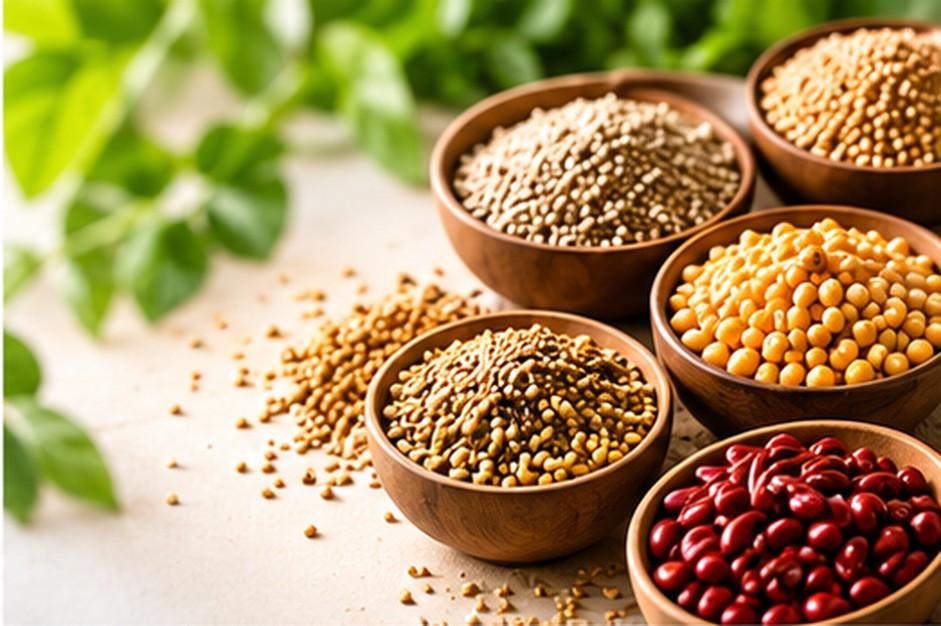
Many everyday Indian foods are good sources of fibre. The figures below come from the ICMR-NIN Indian Food Composition Tables 2017 (IFCT 2017), the national reference for the nutrient content of Indian foods. We picked ten commonly eaten foods from the tables and ranked them by total dietary fibre.
| Rank | Food | Fibre (g / 100 g raw) |
|---|---|---|
| 1 | Chana (Bengal gram), whole | 25.22 |
| 2 | Moong (green gram), whole | 17.04 |
| 3 | Rajma (kidney beans), brown | 16.95 |
| 4 | Almond | 13.06 |
| 5 | Bajra (pearl millet) | 11.49 |
| 6 | Whole wheat flour (atta) | 11.36 |
| 7 | Ragi (finger millet) | 11.18 |
| 8 | Jowar (sorghum) | 10.22 |
| 9 | Guava, white flesh | 8.59 |
| 10 | Fresh green peas | 6.32 |
How to read these numbers
- The IFCT 2017 values are for raw foods. Once cooked, grains and pulses absorb water, so the fibre in 100 g of cooked food is lower than the figures above. What counts for your day is how much you actually eat, not the per-100 g value.
- These are averages of samples from six regions of India, so a particular batch can differ.
- This is a list of ten foods we chose, not a complete ranking of every Indian food. For example, other pulses such as black gram (whole, 20.41 g) and red gram (whole, 22.84 g) also appear in IFCT 2017 with high values.
Group averages from ICMR-NIN
The ICMR-NIN Dietary Guidelines for Indians give average total dietary fibre per 100 g raw weight for each food group: pulses 12 g, nuts 9 g, millets 7 g, cereals 6 g, and about 2 g each for fruits, vegetables, green leafy vegetables and roots and tubers. Because fruits and vegetables are mostly water, their fibre per 100 g is low, yet the guidelines still ask for large quantities of them (400 g of vegetables and 100 g of fruit in the 2,000 kcal food pyramid).
Whole versus refined
Processing matters. In IFCT 2017, whole wheat flour (atta) has 11.36 g of fibre per 100 g while refined wheat flour has 2.76 g. Raw brown rice has 4.43 g and raw milled rice 2.81 g. ICMR-NIN recommends that at least half of the cereals you eat are whole grains such as millets.
This article is general information, not medical advice. If you have a digestive condition, diabetes, or any health concern, talk to a doctor or registered dietitian before changing your diet.